
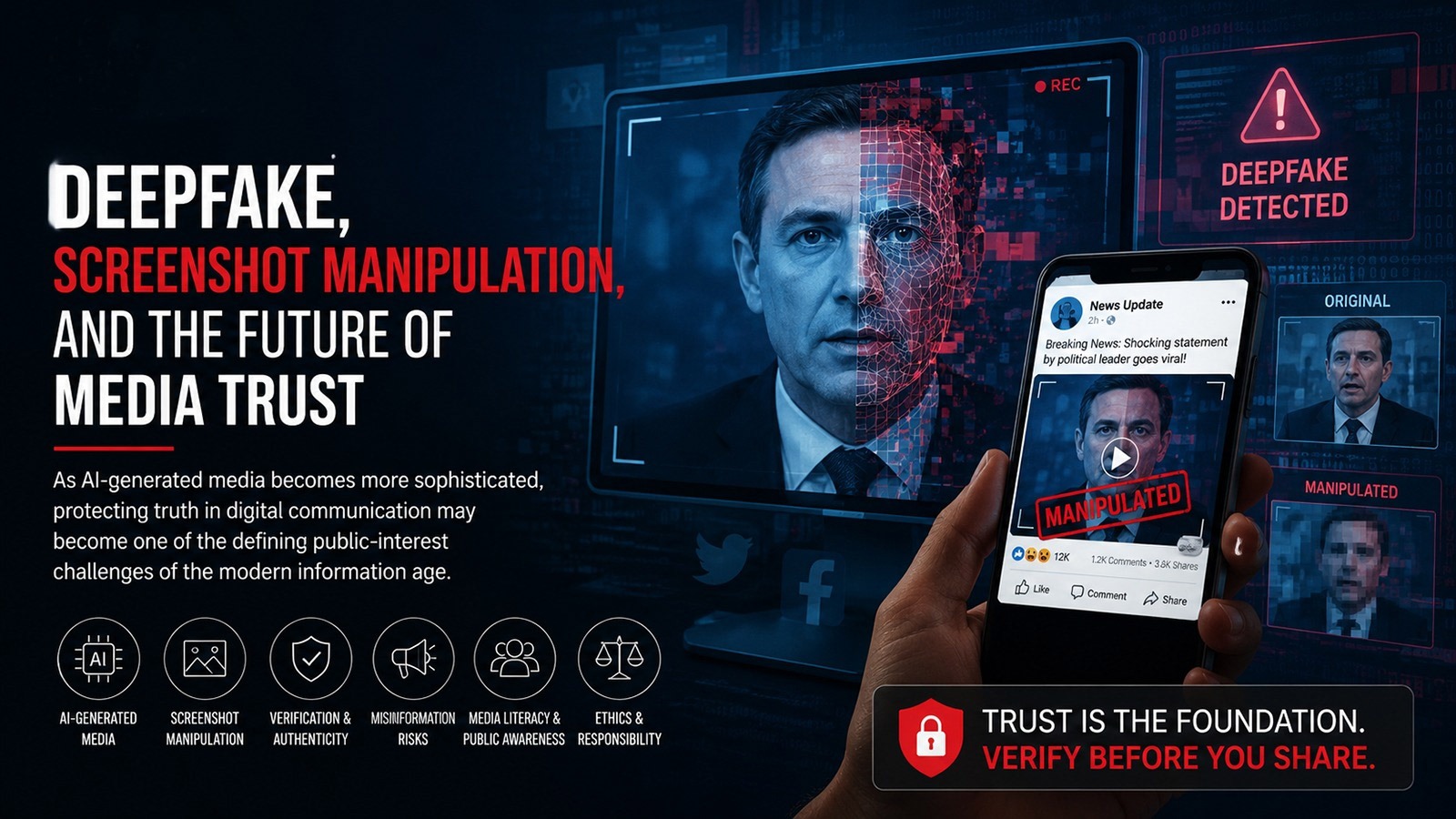
Artificial intelligence is transforming modern communication at an unprecedented speed. While AI has introduced remarkable innovations in journalism, education, healthcare, and digital creativity, it has also created new risks that threaten public trust, democratic discourse, and information integrity. Among the most concerning developments is the rapid rise of deepfake technology and manipulated digital media.
Deepfake technology uses artificial intelligence to
create highly realistic but fabricated audio, video, and image content. What
once required sophisticated visual-effects teams can now be produced using
accessible AI tools within minutes. As these technologies evolve, the
distinction between authentic and manipulated media is becoming increasingly
difficult for ordinary citizens to recognize.
The danger is no longer limited to fabricated videos
alone. A more complex challenge has emerged through screenshot-based
manipulation and recompression techniques that allow manipulated media to
spread across social media platforms while bypassing traditional verification
systems.
Many existing digital forensic tools rely heavily on
metadata, file history, or original source integrity. However, when a
manipulated image or video is repeatedly screenshotted, screen-recorded,
compressed, or reposted across platforms, much of the original forensic
signature disappears. This creates a serious challenge for journalists, media organizations,
cybersecurity professionals, and policymakers attempting to verify authenticity
in real-world digital environments.
In today’s information ecosystem, misinformation spreads
faster than verification. A manipulated image shared during elections,
political crises, social unrest, or international conflicts can influence
public opinion before fact-checkers have an opportunity to respond. The rise of
synthetic media therefore presents not only a technological issue, but also a
profound ethical and democratic challenge.
For journalism, the consequences are especially serious.
Public trust remains one of the most valuable assets of credible media
institutions. If audiences lose confidence in the authenticity of visual
evidence, the long-term impact may weaken trust in legitimate journalism
itself. This creates a dangerous environment where factual reporting and
manipulated propaganda compete within the same digital space.
The challenge is particularly relevant for countries
experiencing rapid digital transformation, where social media consumption often
exceeds traditional media verification mechanisms. In such environments,
manipulated media can fuel political polarization, communal tension,
misinformation campaigns, and cross-border influence operations.
As digital misinformation evolves, media professionals
must increasingly combine journalism with technological literacy. Future media
verification systems may need to move beyond traditional metadata analysis
toward content-based forensic analysis capable of detecting visual
inconsistencies, AI-generated artifacts, geometric distortions, synthetic
facial patterns, and transformation-related anomalies.
Artificial intelligence itself may also become part of
the solution. Advanced AI-driven authenticity analysis systems could help
identify manipulated content even after screenshots, recompression, or
reposting processes degrade conventional forensic indicators. Such developments
may become essential for cybersecurity, digital journalism, and information integrity
efforts worldwide.
At the same time, technology alone cannot solve the
crisis of digital misinformation. Media literacy, ethical journalism, public
awareness, institutional transparency, and responsible communication practices
remain equally important. Journalists, educators, policymakers, and technology
professionals must work collaboratively to protect information credibility
within increasingly complex digital ecosystems.
The future of journalism will not depend solely on faster
communication technologies. It will also depend on society’s ability to
preserve trust, authenticity, and ethical responsibility within an era of
rapidly evolving artificial intelligence.
As AI-generated media becomes more sophisticated,
protecting truth in digital communication may become one of the defining
public-interest challenges of the modern information age.
By Avik Sanwar Rahman







.png)




০ টি মন্তব্য